
If you’ve ever looked at a professionally lit home and thought, “Why does that just feel right?”—there’s usually a reason behind it.
Good outdoor lighting isn’t random. It’s not just about placing fixtures and hoping for the best. There’s structure, balance, and intention behind it… and one of those guiding principles is something called the 5:7 rule.
But here’s the catch—like most “rules” in design, it’s helpful… until it isn’t.
The 5:7 outdoor lighting rule refers to using light intensity and spacing in a balanced ratio—typically placing fixtures or adjusting brightness levels so one area isn’t dramatically brighter than another. It helps create a natural, layered look. However, it’s a guideline, not a strict rule, and should be adjusted based on the property’s architecture and landscape.
What Is the 5:7 Outdoor Lighting Rule?
At its core, the 5:7 rule is about visual balance.
Instead of blasting everything with the same brightness or spacing lights evenly without intention, this rule encourages subtle variation—usually a slightly softer vs. slightly brighter relationship between focal points.
Think of it like this:
- One feature is highlighted at a “5” level
- Another is highlighted at a “7” level
That difference creates depth, contrast, and movement, which is what makes a lighting design feel natural instead of flat.
In high-end landscape lighting design, especially here in the Piedmont Triad, this is what separates “lit” from well-designed.
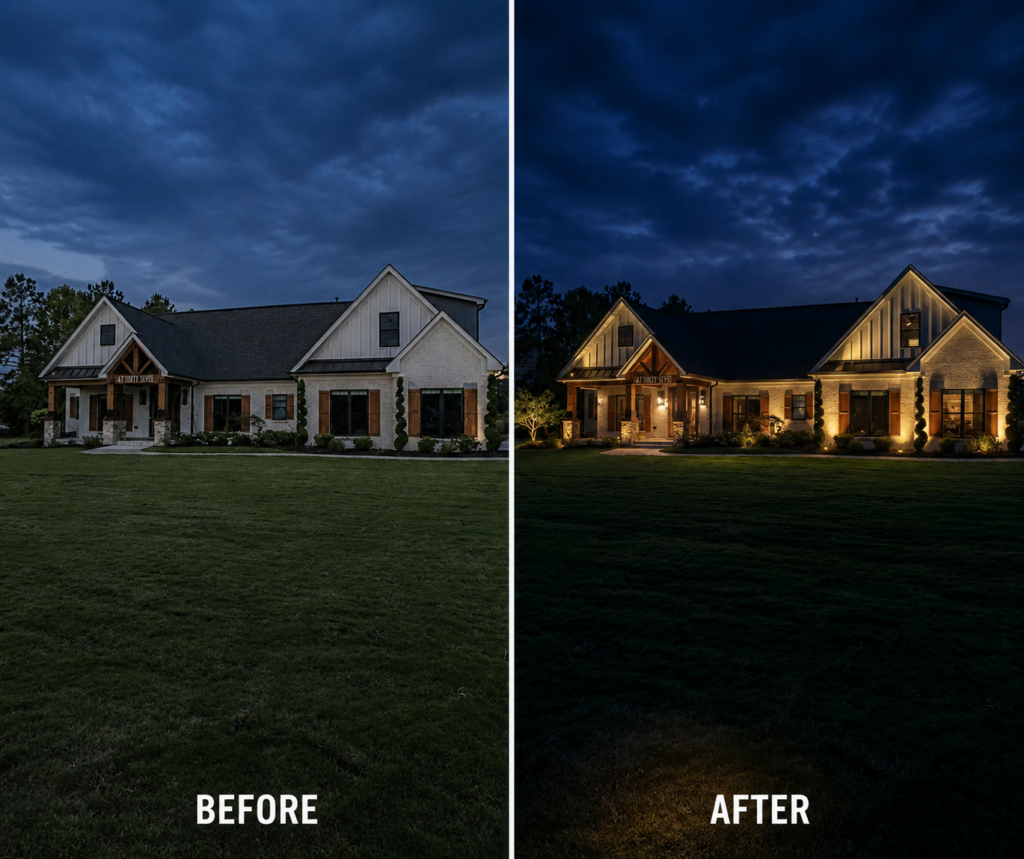
Why This Rule Works So Well
Most homeowners don’t realize this, but uniform lighting actually works against you.
When everything is the same brightness:
- Your eye doesn’t know where to look
- Architectural details get lost
- The home looks flat at night
The 5:7 rule solves that by:
- Creating focal points
- Guiding the eye across the property
- Adding dimension to the home and landscape
This is especially important for outdoor lighting in Piedmont Triad, NC, where homes often have a mix of textures—brick, stone, siding, and mature landscaping that all respond differently to light.
Where the 5:7 Rule Shows Up in Real Life
You’ll see this principle applied in a few key areas:
Highlighting Architecture
Columns, peaks, and entryways are often slightly brighter than surrounding areas to create hierarchy.
Layering Trees & Landscaping
Instead of lighting every tree the same, some are softly washed while others are more defined—creating depth instead of repetition.
Path & Walkway Lighting
Alternating intensity (or spacing) prevents the “runway effect” where everything looks overly uniform.
Permanent Holiday Lighting
Even with permanent holiday lighting, balance matters. Clean, consistent lines are key—but brightness and color intensity still need to feel intentional, not overpowering.
When You Should Break the 5:7 Rule
Here’s where experience really matters.
The best designs don’t follow rules blindly—they know when to ignore them.
1. When the Architecture Demands It
Some homes have strong symmetry or bold features that need equal emphasis, not variation.
2. When You Want a Dramatic Look
If you’re going for a more striking or modern feel, higher contrast (not subtle ratios) can actually work better.
3. Large Properties
On larger estates, strict ratios can get lost. Instead, lighting is often designed in zones, each with its own balance.
4. Functional Lighting Needs
Driveways, steps, and safety areas sometimes require consistent brightness, not artistic variation.
The Biggest Mistake Homeowners Make
Trying to apply rules like this without a full design plan.
The 5:7 rule works best when it’s part of a layered lighting strategy, not a standalone concept.
Without that bigger picture, you can end up with:
- Random brightness levels
- Inconsistent spacing
- Overlit or underlit areas
That’s where professional design makes the difference—especially when you’re investing in something like a permanent system.
Why Design Matters More Than the Rule
At the end of the day, the goal isn’t to follow a formula.
It’s to create an experience.
Great outdoor lighting in Piedmont Triad, NC should:
- Feel effortless
- Highlight what matters most
- Adapt to your home—not the other way around
The 5:7 rule is just one tool in the toolbox.
The real value comes from knowing how to use it… and when not to.
Southern Lights is a Piedmont Triad-based outdoor lighting company with over 30 years of experience specializing in custom landscape lighting, permanent holiday lighting, and outdoor audio systems. Known for design-focused installations and long-term service, the company serves homeowners throughout the Triad, Smith Mountain Lake, and surrounding areas.
FAQs
1. Is the 5:7 rule required for outdoor lighting?
No—it’s a guideline. It helps create balance, but good design depends more on the property than any fixed ratio.
2. Does this rule apply to small homes?
Yes, but in a simplified way. Even smaller properties benefit from subtle variation in lighting intensity.
3. Can I use the same brightness for all fixtures?
You can, but it often results in a flat look. Variation is what creates depth and visual interest.
4. How does this affect permanent holiday lighting?
While spacing is consistent, brightness and color use should still feel balanced—not overwhelming.
5. Do I need a designer to apply this correctly?
Not always—but most homeowners find it difficult to achieve a cohesive look without a professional plan.
We’d be happy to take a look at your home and show you what’s possible. No pressure—just a clear plan tailored to your space.